2nd December 2025
New phased approach will strengthen Ireland’s competitiveness while supporting businesses and workers
Peter Burke, Minister for Enterprise, Tourism and Employment, and Alan Dillon, Minister of State for Employment, Small Business and Retail, today announced the publication of a new Roadmap for Minimum Annual Remuneration (MAR) Salary Thresholds. The first increase will take effect 1 March 2026.
The Roadmap outlines a gradual approach to increasing salary thresholds across all employment permit types, while removing very low thresholds on a phased basis for certain roles in the agri-food and healthcare sectors.
Key changes
- From 1 March 2026:
- minimum salary for General Employment Permits will rise from €34,000 to €36,605
- minimum salary for Critical Skills Employment Permits will increase from €38,000 to €40,904
- for meat processors, horticultural workers, healthcare assistants, and home carers, the minimum salary will increase from €30,000 to €32,691
- Lower starting thresholds will apply for recent graduates, reflecting their early career stage
Why this matters
This new roadmap follows a review of the 2023 plan to raise salary thresholds over two years. The review considered:
- feedback from public consultation, which received over 150 submissions from employers, permit holders, trade unions, and representative bodies
- business challenges linked to rising costs and global economic conditions
- concerns from migrant worker advocacy groups about permit renewals under quickly implemented higher thresholds
Instead of completing the increases by 2026, the new plan introduces a gradual implementation through to 2030. This approach ensures balance between worker rights and business sustainability, in line with the Employment Permits Act 2024.
Statements from Ministers
Minister Peter Burke said:
“The intention of this Roadmap is to strengthen Ireland’s competitiveness in attracting the vital skills and talent our economy needs—especially in sectors like healthcare and construction. To balance the rights of workers with the needs of businesses, the changes will be introduced on a phased basis. This will give all sectors sufficient time to prepare.”
Minister Alan Dillon added:
“Economic migration plays a vital role in our economy and society. Migrant workers bring essential skills and cultural diversity that enrich Irish life. These changes will not only ensure we offer good quality employment, with salary thresholds increasing in line with average earnings, but also strengthen Ireland’s competitiveness in attracting and retaining global talent. I want to thank all those who participated in the consultation—their feedback was invaluable in shaping a balanced and sustainable approach.”
Next steps
The first increase will take effect on 1 March 2026, with further adjustments phased in through 2030. Full details of the roadmap are available on Employment Permits Minimum Annual Remuneration: Outcome of the Roadmap Review 2025
ENDS
Notes to editors
The Employment Permits System
Ireland’s policy prioritises sourcing labour and skills needs from within the workforce of Ireland, the European Union, and other European Economic Area (EEA) states. Employment permit applications are focused on recruiting highly skilled personnel from outside the EEA where skills cannot be met through normal recruitment or training.
Employment permit policy addresses medium-term skills deficits but is not intended as a long-term substitute for upskilling Ireland’s resident workforce. Lifelong learning and maximising the potential of EEA nationals remain central to meeting future skills needs.
Critical skills roles in the public service will be exempt, where the relevant qualification is held, as they are covered by existing public pay agreements and collective bargaining arrangements.
Review of the Roadmap of Increases to MAR Thresholds
In 2023, alongside a review of the occupations lists, the Department of Enterprise, Trade and Employment (DETE) reviewed Minimum Annual Remuneration (MAR) thresholds. It found that thresholds had stagnated since 2014 and had not kept pace with inflation and economic changes.
The original roadmap announced increases from January 2024, but following consultation with the healthcare sector, increases for health care assistants, home carers, and care workers were deferred to January 2025.
In response to concerns about rising business costs—including statutory sick leave and pension auto-enrolment—a further review commenced in Summer 2024. Submissions from sectors and CSO data informed this process.
What is MAR
Minimum Annual Remuneration (MAR) is the lowest annual salary that must be paid to a non-EEA worker for an employment permit to be issued or renewed. There is also an associated hourly rate for each MAR that must also be satisfied.
Hourly rate equivalent of MAR
The hourly rate equivalent of the MAR is calculated by dividing the MAR by 2,028 hours, which represents a standard full-time working year (39 hours per week × 52 weeks).
If the job is less than 39 hours per week:
- the MAR threshold or minimum annual salary required for the employment permit stays the same
- as a result, a higher hourly equivalent is required to satisfy the minimum annual remuneration
If the job is more than 39 hours per week:
- every extra hour (or part of an hour) above 39 must be paid at least the minimum hourly rate
Example
If the MAR is €36,605, the hourly rate equivalent is:
€36,605 ÷ (39*52) = €18.05 per hour
In this case, if the hours worked are less than 39, then the hourly rate will have to increase to ensure the MAR of €36,605 is still met.
If the hours are greater than 39 per week, then each hour above 39 must also be paid at a minimum of €18.05 per hour, in excess of the MAR.
Indexation
Indexation ensures MAR thresholds reflect changes in average earnings across the Irish labour market. If average earnings have increased since a permit was issued, the salary required at renewal must rise accordingly.
The indexation rate is based on CSO data. Over the past five years, the average annual adjustment has been 4.9%, with yearly rates varying between 3.1% and 7.6%.
Key elements of the new roadmap
- General Employment Permit (GEP) MAR thresholds will rise by 7.66% in March 2026, instead of the previously planned 14.7%.
- Critical Skills Employment Permit (CSEP) thresholds will rise by 7.66%, instead of 15.8%.
- Sub-standard MAR thresholds (for example, healthcare and agri-food sectors) will be phased out by 2030, rather than 2026, increasing by 9% in 2026.
- Lower MAR thresholds for recent graduates:
- GEP: Graduates from Irish third-level institutions (Level 8 or above) within the previous 12 months.
- CSEP: Graduates from any recognised third-level institution (Level 8 or above) relevant to the occupation applied for, who have graduated in the 12 months before applying.
- Public sector roles, that otherwise qualify for the CSEP with a relevant qualification, and are subject to national pay agreements will be exempt from CSEP MAR thresholds. This will also apply to community and voluntary organisations whose pay scales are linked to the public sector pay deal.
- The previously deferred increase to €30,000 for healthcare assistants, home carers, and care workers is now aligned with the same schedule of annual increase as the other roles with below standard MARs, meat processing operatives and horticulture workers.
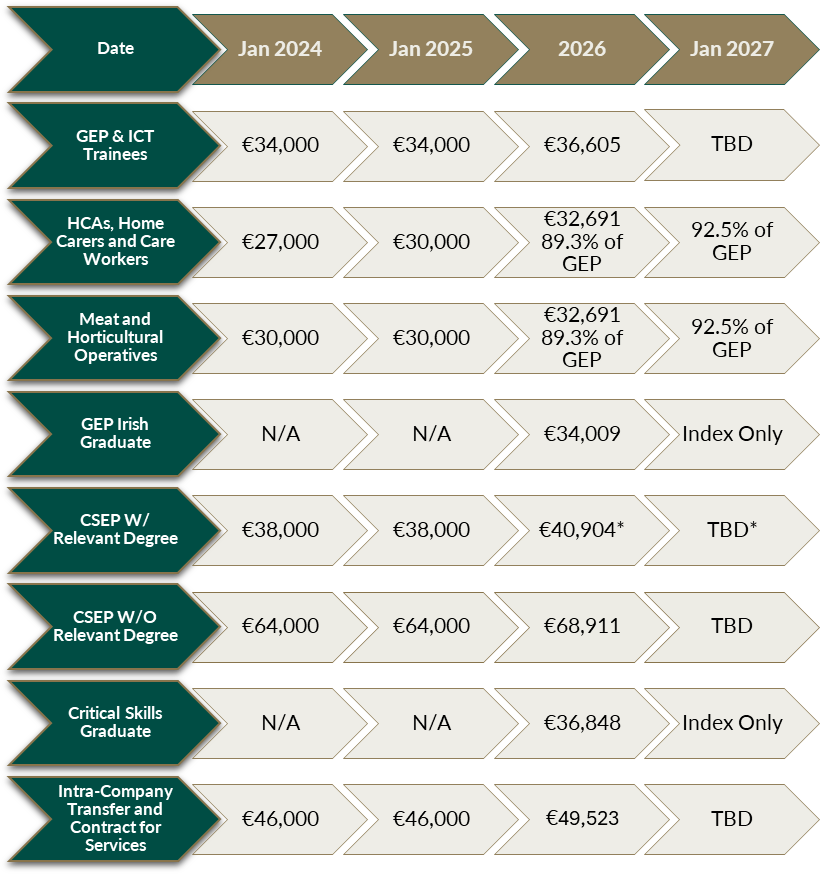
* Critical skills roles, subject to the public service pay agreement or linked agreement are to be exempt from this, subject instead to the pay agreement pay scales. This will also apply to community and voluntary organisations whose pay scales are linked to the public sector pay deal.
TBD = To Be Determined following annual review and indexation.
Index Only = Will adjust based on national average earnings index.
Back to Department News