Overview
Key features of SAP’s engagement
The challenge
The solution
Conclusion
Overview
Since its inception, SAP Ireland has been an active industry partner in the University of Galway’s IdeasLab Enterprise Challenge programme, supporting student teams to develop real-world solutions through design thinking, mentoring, and prototyping.
Key features of SAP’s engagement
Structure and focus
An 8-week, hands-on programme organised and facilitated by the University of Galway IdeasLab where SAP presents a real-world business challenge and students work through a design sprint, including empathy, problem definition, ideation, prototyping, and testing.
Mentorship
Student teams receive weekly guidance from SAP experts.
Outcome
Innovative solutions presented by student teams to an SAP and IdeasLab judging panel with a winner selected based on challenge understanding, ideation, engagement with mentors and final presentation.
The challenge
Technical Support Engineers work directly with SAP customers to resolve questions and issues related to SAP solutions. These engagements begin when a customer submits a support case (ticket), covering a wide range of topics such as 'how-to' questions, configuration challenges, and software defect identification. Engineers also collaborate closely with SAP Engineering teams to diagnose root causes and implement fixes.
At the initial stage of ticket creation, critical information required to understand and reproduce an issue—such as system details, user context, reproduction steps, or screenshots—is often missing. As a result, engineers must spend additional time requesting clarification from customers, delaying issue diagnosis and resolution.
While SAP solutions play a critical role in customers’ business operations, customers cannot reasonably be expected to know exactly what technical information is required when an issue arises. This gap leads to inefficiencies for support teams and negatively impacts the overall customer experience.
Key challenge: How can AI be leveraged to reduce the effort required from both customers and SAP Support Engineers, enabling faster understanding of reported issues and allowing investigations to begin immediately upon ticket submission?
The solution
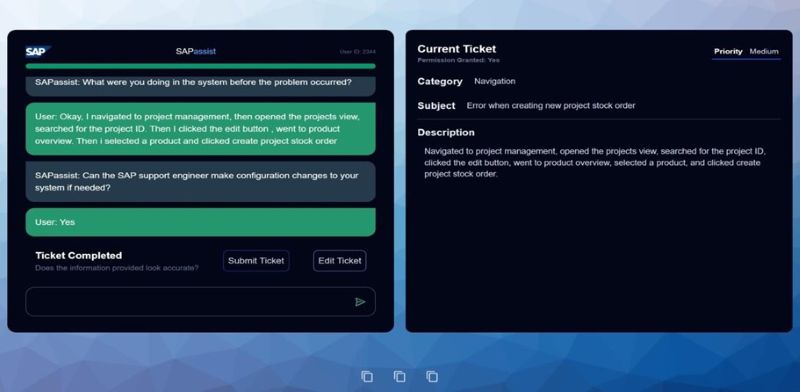
The winning student team delivered an innovative concept named SAPassist, an AI-powered assistant designed to guide SAP customers through the creation of a support case. Leveraging generative AI capabilities, the solution interactively prompts users for the relevant technical and contextual information required to accurately describe an issue at the point of ticket submission.
The team developed a working prototype demonstrating how SAPassist could engage customers in a conversational flow, helping them articulate system context, user actions, and error conditions in a structured and intuitive manner. In addition to the prototype, the team outlined a detailed implementation roadmap, addressing considerations such as model fine-tuning, ongoing operational costs, and scalability.
Crucially, the solution also explored how SAPassist could be integrated into the existing SAP support infrastructure. The team highlighted expected benefits in efficiency, resilience, and cost management, while identifying opportunities for future enhancement and broader application across SAP’s support ecosystem.
Conclusion
This Enterprise Challenge demonstrated the value of close collaboration between industry and academia in addressing real-world business problems. Through structured mentoring and hands-on engagement, SAP Ireland enabled student teams to apply design thinking and emerging technologies to a complex, high-impact support scenario.
The winning SAPassist concept illustrated how generative AI can be applied thoughtfully to improve both customer and employee experiences. By enabling more complete and actionable support cases at the point of submission, the solution has the potential to accelerate issue resolution, reduce effort for support engineers, and improve overall customer satisfaction.
Beyond the technical outcome, the challenge reinforced SAP’s commitment to digital inclusion, innovation, and talent development. By engaging multidisciplinary student teams and providing access to real industry challenges, SAP continues to foster inclusive learning opportunities while building strong partnerships with academic institutions.
Initiatives such as the University of Galway IdeasLab Enterprise Challenge highlight the longterm value of these collaborations and their potential to shape future talent, innovation, and impact across SAP’s ecosystem.
By aligning with the principles of Ireland’s Charter for Digital Inclusion, this initiative also demonstrates how industry–academic collaboration can contribute to a more accessible and equitable digital future.
The charter emphasises ensuring that everyone, regardless of background, ability, or digital confidence, can participate fully in a society increasingly shaped by technology. SAPassist reflects this ethos by simplifying complex support processes, reducing technical barriers, and empowering all users to engage more confidently with digital tools. Through initiatives like the IdeasLab Enterprise Challenge, SAP not only advances innovation but also helps embed inclusive design, accessible user experiences, and digital skills development into the next generation of talent, supporting the broader national ambition of a digitally inclusive Ireland.