19th October 2026
Two years after the launch of the circa €300 million Environmental Aid Fund, Minister Burke and Minister O’Brien publish report describing Ireland’s Industrial Decarbonisation progress
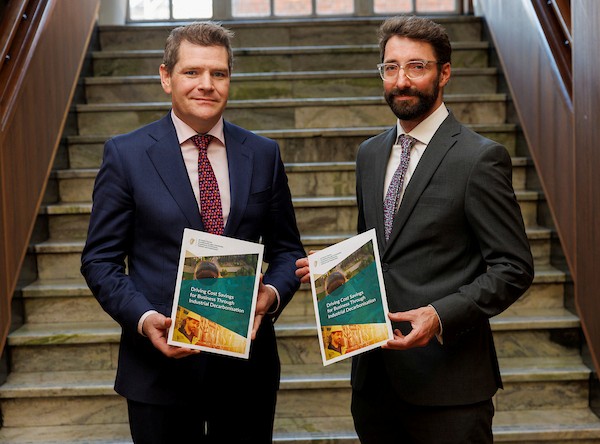
L-R: Peter Burke, Minister for Enterprise, Tourism and Employment and Ross O’Colmain, Head of Business Expansion and Sustainability Solutions
The Minister for Enterprise, Tourism and Employment, Peter Burke, and the Minister for Climate, Energy and the Environment, Darragh O’Brien, today published the report, Driving Cost Savings for Business Through Industrial Decarbonisation. The report outlines how Irish-based industries are being supported by the government and its agencies to invest in decarbonisation, enhancing the long-term competitiveness and resilience of businesses.
Enterprise Ireland, IDA Ireland, and the Sustainable Energy Authority of Ireland (SEAI) collectively have €500 million available through to 2030 to support investment in energy efficiency, promote the uptake of renewable energy, and incentivise capital investment in decarbonisation projects.
Launching the report, Minister Burke commented:
"The report highlights the excellent work being undertaken by our state agencies and their client companies to decarbonise Ireland’s industrial sector. Over the past two years, €163 million has already been allocated through the Environmental Aid Fund to support 43 decarbonisation investments. Together, these projects are expected to remove approximately 214,210 tonnes of CO₂ equivalent from industrial emissions in the coming years.
"These grants are backed by more than €1 billion in private investment from the companies involved, demonstrating the strategic importance of decarbonisation decisions at the highest levels of these organisations.
"The government is committed to achieving our climate action goals. That is why I am working closely with my colleague, Minister O’Brien, to ensure that the infrastructure required by industry is put in place.”
Commenting on the report, Minister O’Brien said:
“Ireland must decarbonise its industrial sector to remain both environmentally sustainable and economically competitive. This was recognised in the government’s Action Plan on Competitiveness and Productivity, which highlighted that Ireland’s future economic growth could be constrained unless new and existing industries have access to reliable renewable energy sources. Energy affordability is a priority for me, and for this government. I and my government colleagues have brought in a package of support measures, totalling €1.4 billion, to help to reduce the cost burden for households and business across the country – at the fuel pump, supporting those most at risk of energy poverty, and helping key sectors that are critical to keeping our economy moving.
“Our focus is very much on energy – on sustainability, on security and, of course, on affordability. Continued and enhanced energy supports that will help people today and tomorrow, have been informed by the work of the National Energy Affordability Taskforce, which I chair. For the taskforce, there is a particular focus on those most vulnerable to volatility in the price of imported fossil fuels. And that will be a continued focus.
“We also know that, in the medium to long term, the best way to insulate ourselves against rising energy costs is to upgrade our homes and business, and to transition to our own home-grown renewable energy. That’s why, at the end of September, I announced a suite of enhanced and new SEAI measures including a short term doubling of the grant rate for the Non-Domestic Microgeneration Grant Scheme, and a substantial increase in grant aid for heat pumps and solar thermal under the Business Energy Upgrades Scheme. Budget 2027 means that we can accelerate the roll-out, to do more, and do it faster.
“Today’s report highlights the importance of accelerating investment in renewable energy and our electricity grid. Providing industry with access to reliable, clean power will enhance competitiveness, reduce energy costs, and strengthen energy security in the face of global fuel price volatility.”
Ross O’Colmain, Head of Business Expansion and Sustainability Solutions:
“Environmental Aid is delivering for Irish industry. Enterprise Ireland clients are being supported to invest in measures that decarbonise their operations, deliver energy security and enhance their competitiveness in international markets. Demand remains strong across food, beverage, cement and other energy-intensive sectors, and we look forward to continuing to work with government to support this pipeline and build on the progress made to date.”
Note for editors
Emissions reduction
Ireland’s largest industrial emitters are primarily in the cement, alumina, food & beverage, pharmaceutical and chemicals sectors. These industries employ thousands of people across the country, generate billions in revenue annually, and are critically important for the Irish economy.
Under the Environmental Aid Scheme, the circa €300 million Environmental Aid Fund is being used by Enterprise Ireland and IDA Ireland to support investment in energy efficiency, to promote the uptake of energy from renewable sources and to encourage environmental studies. In addition, the agencies are providing €141m in grant aid through other funding mechanisms, in support of industrial decarbonisation measures, including some projects which began prior to the introduction of the circa €300 million fund. These have an expected emissions savings of 132,167 tonnes of CO2 equivalent.
Many of these investment commitments will be completed in the latter half of the decade, which means that the removal of more than 346,377 tonnes of CO2 equivalent from industry is not yet captured in the Environmental Protection Agency’s (EPA) projections and progress reports on the reduction of industrial emissions.
Note: The cost per tonne of carbon abatement varies depending on how advanced the decarbonisation projects are and differs from sector to sector.
Find out more on the Environmental Aid Scheme
All Island approach
Enterprise Ireland has taken their decarbonisation brief a step further, by building productive links with their counterparts in Northern Ireland - Invest Northern Ireland, using the Shared Island Fund. In 2024, the two agencies received €20 million in funding through the Department of An Taoiseach to operate a Sustainability Demonstrator Fund, which is designed to support novel solutions in sectors that are particularly difficult to decarbonise.
Up to the end of Q2 2026, 4 projects have been approved for funding to a value of €5.75 million. When combined the projects will remove more than 44,000 tonnes of CO2 equivalent scope 1 and 3 emissions. Building on this success, the government has announced an allocation of €20 million from the Shared Island Fund, for a new Shared Island Industrial Sustainability Challenge Fund. This will be complemented by match funding of €3 million from Enterprise Ireland and €3 million from Invest Northern Ireland, bringing the total fund to €26 million.
The fund will support first-of-a-kind industrial sustainability projects across the island over the period 2027-2030, focusing on the following challenge areas:
- Flexible Industrial Electrification
- Hard-to-Abate Climate Technologies
- Water Efficiency
- Circularity, Resource Efficiency, and the Bioeconomy
Find out more on the Shared Island Industrial Sustainability Challenge Fund
Back to Department News